Last updated October 30, 2026
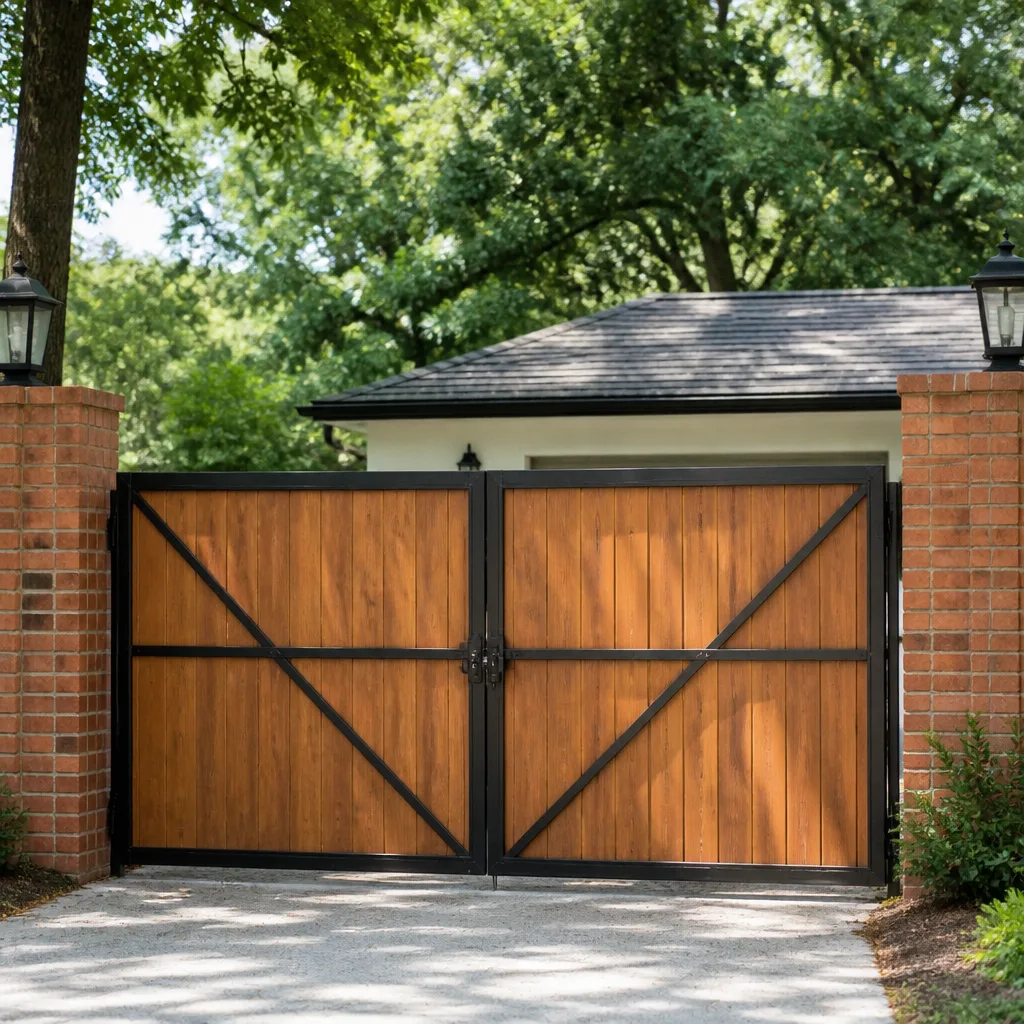 Wood & steel frame
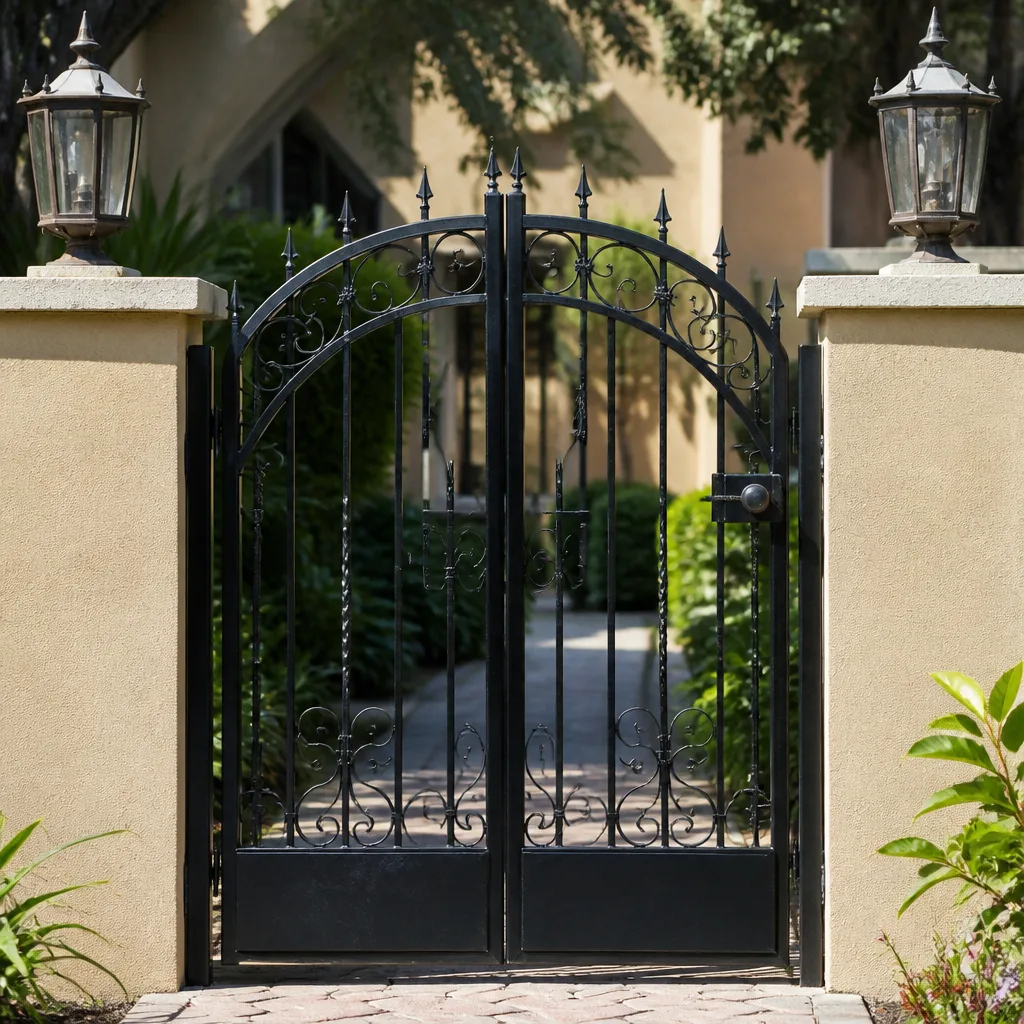 Wrought iron
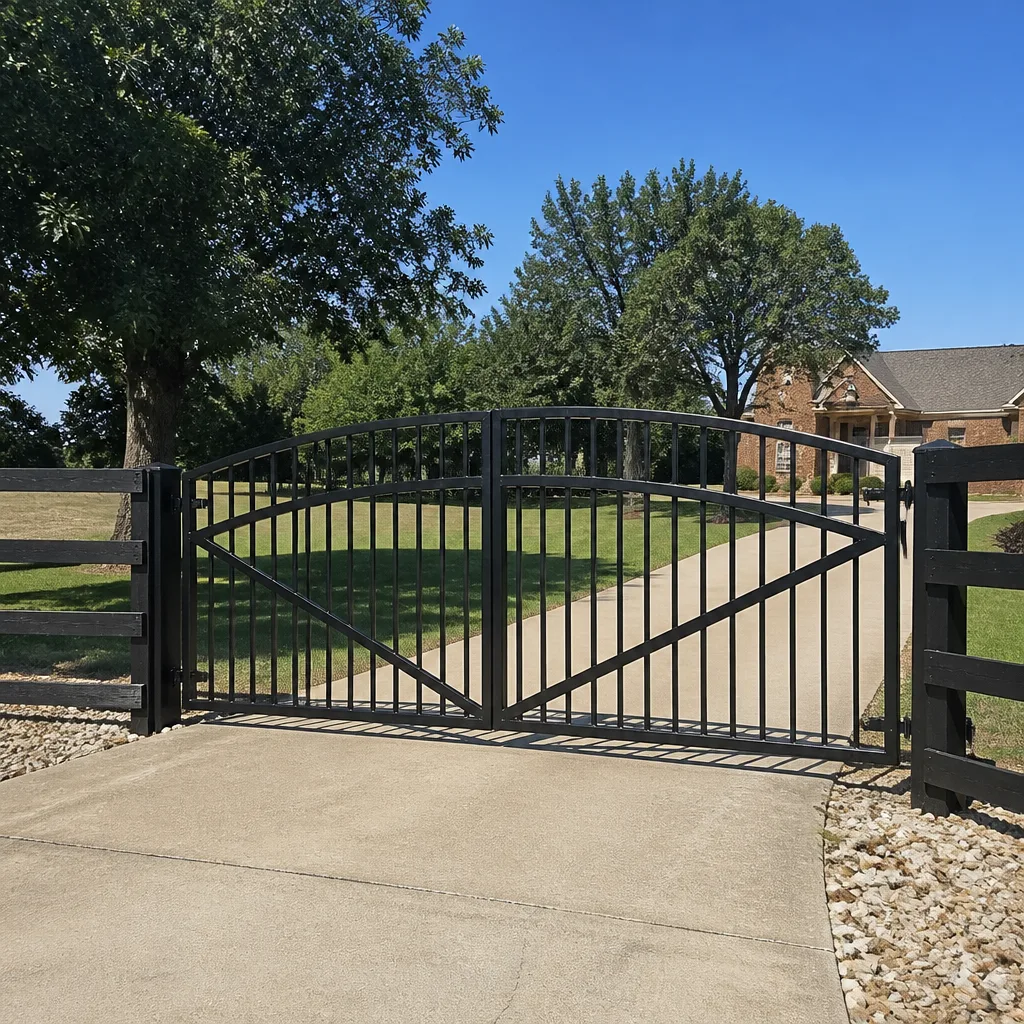 Farm & ranch
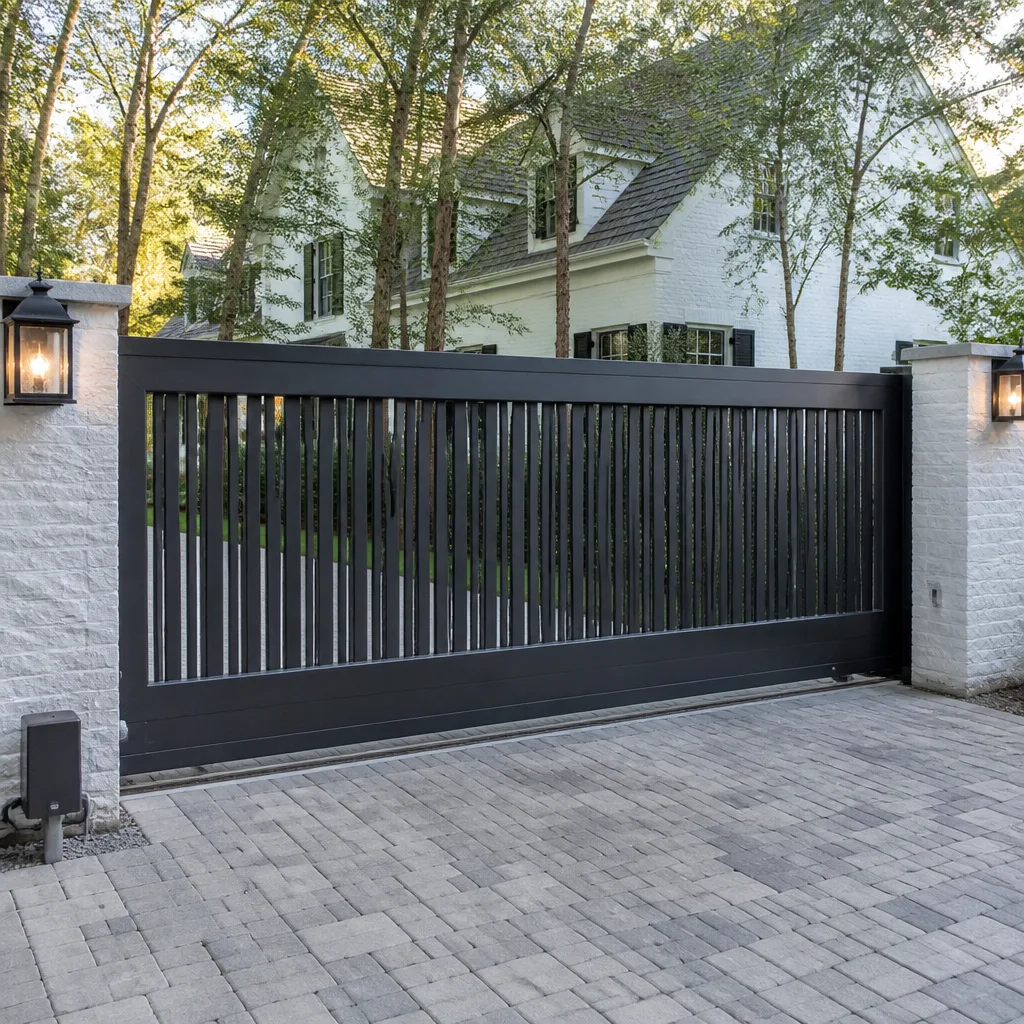 Sliding driveway gates
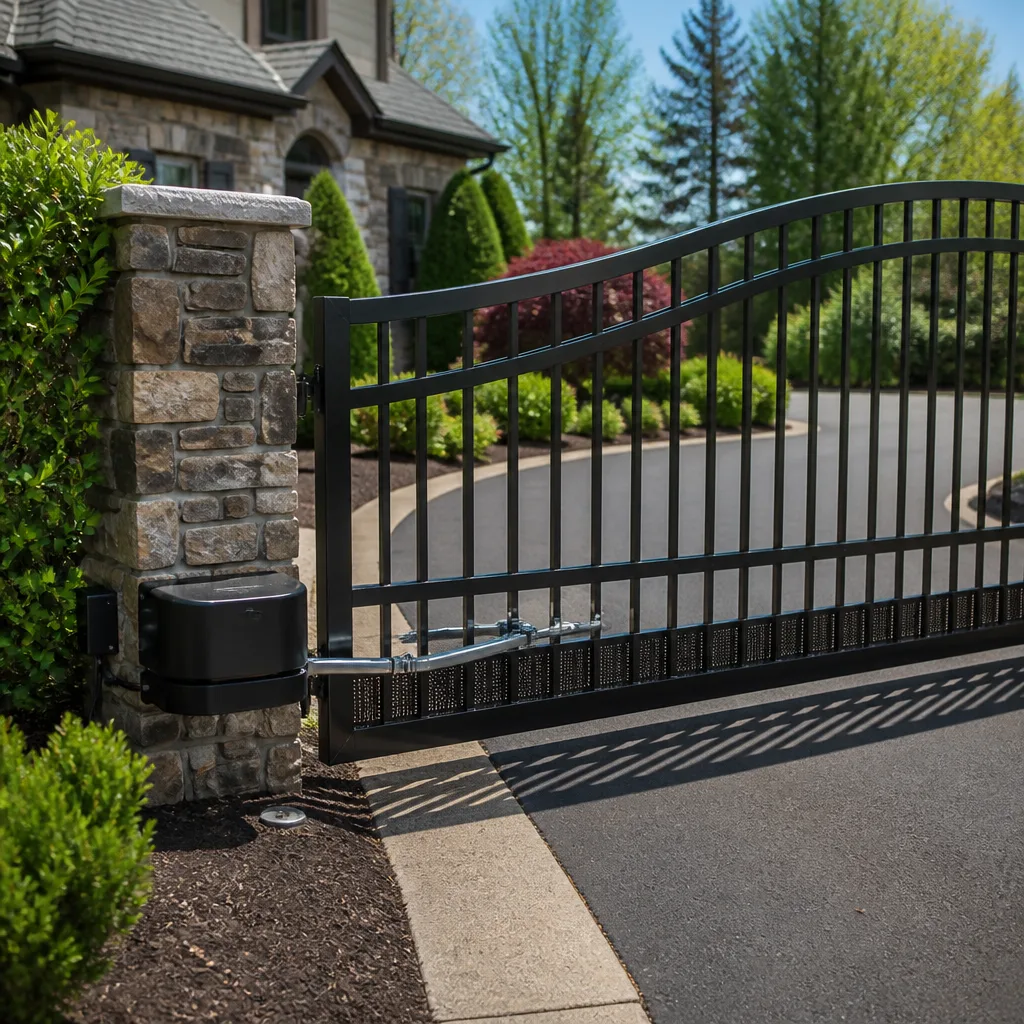 LiftMaster operators
Free on-site gate assessment - hinges, posts, and your LiftMaster or Nice gate operator checked before anything is quoted
The assessment is free and the quote is the invoice.
Get your free estimateDIY vs Professional Gate Repair: The Hollywood Homeowner’s Decision Guide
Most gate repair advice online assumes a generic suburban house somewhere with mild weather and no HOA. Hollywood, FL breaks that model fast. Salt air corrodes control boards faster than inland heat ever will. Hurricane-season wind loads test hinge welds that looked fine in March. And many Hollywood neighborhoods, especially gated communities east of 95, have association rules that make “fix it yourself” legally beside the point. This Gate Repair guide separates the repairs where DIY makes sense from the ones where it creates a liability you’ll pay for twice. Along the way, we’ll cover Florida’s actual legal line on DIY work, the HOA documentation trap, and the quiet math of when a $200 service call beats a $900 parts mistake.
Quick Answer
DIY gate repair makes sense for low-risk tasks like cleaning tracks, lubricating hinges, remating remotes, and adjusting opener force settings. Professional repair is the only sensible option for jobs involving electrical wiring, operator replacement, spring or counterweight tension, new footings, or any work an HOA requires to be contractor-documented. In Hollywood specifically, the salt air corrosion profile and HOA density shift the DIY/pro line further toward professional than most national guides recommend.
Styles & brands we work with
Table of Contents
- The Repair Matrix: What’s Actually Safe to DIY
- Florida Licensing Law: What Hollywood Homeowners Can Legally Do
- The HOA Factor: Documentation Rules in Hollywood Communities
- Salt Air and Coastal Wear: Why Hollywood Gates Fail Differently
- The ‘Wrong Operator’ DIY Risk: Duty Cycle and Gate Weight
- When Professional Repair Is Cheaper Than DIY
- Common Mistakes to Avoid
- When to Call a Professional
- Frequently Asked Questions
The Repair Matrix: What’s Actually Safe to DIY
We service nine gate operator brands across Hollywood, and the DIY question comes up on every third call. The honest answer: some tasks take twenty minutes and a can of lithium grease. Others need a multimeter, a torque wrench, and an understanding of how a motor’s stall current interacts with a safety edge. Here’s the line, drawn from what we see in the field.
Safe DIY repairs fall into four categories. First is lubrication of hinges, rollers, and chains: a ten-minute job with white lithium grease on the hinge pins and a light machine oil on the chain. Second is track and guide cleaning, especially on slide gates where sand from Hollywood’s coastal lots works its way into the wheels and causes binding. Third is remote programming, which most brands including Ghost Controls and Mighty Mule document in a user manual that takes five minutes to follow. Fourth is photo eye realignment, where you loosen a bracket, re-aim the beam, and tighten it back down.
Professional-only repairs account for everything else that matters. Any electrical work past swapping a battery in a remote. Operator replacement, regardless of brand. Spring tensioning or counterweight adjustment, where stored energy can release without warning. Gate wheel replacement in a cantilever slide system, where the gate must be cribbed and leveled properly. Concrete or steel post repair, which affects the entire geometry of the swing. Control board diagnostics on any brand we service, from DoorKing to Elite, where the schematics assume a working knowledge of low-voltage logic circuits and fault code interpretation.
The matrix holds across Hollywood: lubrication is lubrication, but the moment a repair requires touching the electrical supply, the logic board, or the mechanical tension components, professional skill stops a small problem from becoming a big one. For deeper reading, see our Gate Repair Emergency Preparedness Guide for Hollywood Homes.
Florida Licensing Law: What Hollywood Homeowners Can Legally Do
Florida law is actually more permissive for homeowners than most people assume, but the exception has sharp edges. Under Florida Statute 489.103, a property owner may act as their own contractor on their own residence without holding a license, so long as the work is not structural, not electrical beyond replacement-grade tasks, and not performed on a rental or commercial property. The moment the property becomes income-generating, or the gate system serves a multi-unit community, the exemption evaporates.
For gate repair specifically, the relevant line is the electrical component. Automated gate operators are hardwired into the building’s electrical system. Florida requires any new electrical circuit installation or modification to be performed by a licensed electrical contractor. Replacing a fuse does not cross that line. Running new conduit from the panel to a gate operator does. The same holds for low-voltage integration when it ties into a building access control system: by the time a Hollywood property manager calls us about a card reader tied to a DoorKing 9150, the work is legally contractor territory because it touches life safety and building ingress.
The structural side matters too. A swing gate post that has rotted at the base, common in Hollywood’s saturated soil during summer rains, is holding a moving mass of several hundred pounds. Replacing that post with a properly sized footing is structural work. The permit requirement depends on the municipality, but Hollywood’s building department requires permits for gate installations that include new concrete work or electrical runs. We’ve seen homeowners skip the permit, finish a clean-looking repair, and then discover at resale that the unpermitted work has to be disclosed as a material defect. That $300 savings becomes a closing-delay problem years later.
The practical reading, in our experience across hundreds of Hollywood service calls: the homeowner exemption covers maintenance, not modification. Lubrication, cleaning, remote programming, sensor cleaning, and hinge tightening are maintenance. Anything that changes the way the gate operates is modification, and modification without a license is what creates the insurance and resale exposure.
The HOA Factor: Documentation Rules in Hollywood Communities
Hollywood’s eastern neighborhoods, from Hollywood Lakes up through the gated enclaves near Dania, carry a rule that most national DIY gate guides never mention: the HOA wants paper. Specifically, a licensed contractor’s invoice or work order before the common-area or boundary gate work counts as compliant. That means even a repair you’re perfectly capable of performing yourself can become a violation if the association’s architectural review committee requires contractor documentation.
The reasons are simple on the HOA side. Shared gates are a liability pool. If a repaired swing gate fails and damages a resident’s vehicle, the association’s insurer wants to see that a licensed professional did the repair, not a homeowner with a socket set. Individual lot gates are less prone to this, but the trend in Hollywood’s newer developments, especially those built after 2000 with decorative aluminum drive gates, is to require documentation for any work visible from the street.
What this means practically: before you spend a Saturday morning on a gate repair in a Hollywood HOA, check your governing documents for two clauses. First, a contractor-licensing requirement for gate or perimeter work. Second, an architectural approval trigger for “mechanical equipment” replacement, which is the category automated gate operators fall into. We’ve had Hollywood customers tell us their association rejected a perfectly functional DIY operator swap because the board required a licensed contractor’s signature on the installation form. The DIY freedom to do the work exists in Florida law. The HOA’s right to enforce a documentation standard exists in the deed restrictions. Those two can both be true at once, and the HOA wins on its own property.
The workaround that keeps everyone happy: do the small maintenance tasks yourself, keep a clean record of what you did, and contract out anything structural or electrical. When the HOA asks, you have both the maintenance log and the licensed invoice for the meaningful work.
Salt Air and Coastal Wear: Why Hollywood Gates Fail Differently
Hollywood sits on the Atlantic, and the air carries more salt than the county’s inland communities see all year. For gate hardware, that means the standard national maintenance schedule understates what a Hollywood gate needs. We see it most in two places: control boards and hinge stainless steel.
Control boards in salt air corrode at the solder joints and the terminal strips. The failure mode is usually intermittent: the gate works on Tuesday, refuses to open on Wednesday evening, works again Thursday. A homeowner with a multimeter might chase that for a weekend and never find it, because the corrosion is microscopically bridging a low-voltage signal path, not a visibly damaged component. On boards in the Ghost Controls and Mighty Mule residential lines, the corrosion often starts at the antenna connection and creeps inward. On commercial-grade boards like DoorKing and Elite, the failure is usually at the loop detector terminals, where the board’s sensitivity to the salt-accelerated oxidation is highest.
Hinge stainless steel in Hollywood is a materials problem, not a workmanship problem. Most decorative aluminum drive gates ship with 304 stainless hinges, which is standard nationally. Within three to five years of salt air exposure, 304 shows pitting at the weld points and around the fasteners. That pitting weakens the hinge under repeated load, and the first sign is a gate that sags slightly at the latch side, then needs a firmer pull to close. Some Hollywood homeowners upgrade to 316 stainless at replacement time, which doubles the hinge cost but extends life significantly in this specific environment.
The practical takeaway for a Hollywood DIYer: if you’re diagnosing an intermittent electrical fault and the board shows any white or green crust at the connectors, that’s not a cleaning job. Oxidized boards need replacement or proper terminal restoration, and applying a wire brush or contact cleaner to a corroded board often accelerates the damage. We’ve replaced boards this year where a homeowner’s cleaning attempt bridged two terminals that were already compromised. The salt air makes electrical DIY in Hollywood a narrower path than it is in Weston or Cooper City.
The ‘Wrong Operator’ DIY Risk: Duty Cycle and Gate Weight
The most expensive DIY mistake we see in Hollywood is not a bad solder joint. It is a homeowner who replaces an operator with a unit rated for a gate half the size. The symptoms take months to show. The operator works fine for the first few weeks, then starts tripping its thermal overload in the afternoon heat, then burns out a transformer entirely. By the time we open the cover, the installation looks clean, but the nameplate says the unit is rated for 300 pounds, and the gate is a 700-pound wrought iron swing gate that catches the breeze off the Intracoastal.
Gate operator manufacturers rate their units by two numbers that matter: maximum gate weight and duty cycle. Duty cycle is the percentage of time the motor can run within a ten-minute window without overheating. Residential operators from Ghost Controls and Mighty Mule are typically rated for light to medium residential duty cycles: fine for a single-family home where the gate cycles a dozen times a day. Commercial operators from DoorKing and Elite are rated for continuous or high-cycle duty, which is what matters when a Hollywood property gets 300 cycles a day from residents, delivery drivers, and visitors.
A homeowner replacing their own operator typically shops on price and brand recognition, not on weight or cycle ratings. The result is an operator that works in demo and fails in daily use. When the motor overheats and trips, the gate stops mid-travel. A stopped gate on a Hollywood driveway is a security open door or a blocked vehicle, depending on where it froze.
The other half of the wrong-operator risk is warranty. Every major gate operator brand writes their warranty to be voidable when the unit is installed outside its published specifications. Wrong gate weight, undersized power supply, wrong duty cycle, or lack of a hardwired safety sensor: the brand denies the claim, and the homeowner pays for the replacement out of pocket. We’ve seen this exact scenario more than once, where a homeowner’s $400 self-installed operator failed at month eight, the warranty claim was denied for an undersized unit, and the fix required not only a new operator but rewiring the power supply that had been running out of spec the whole time.
The lesson from the Hollywood side of this: before any operator replacement, know your gate’s actual weight, material, length, and daily cycle count. Then match the operator to those numbers. If that matching involves published engineering tables and an amperage draw calculation, you’re in the professional’s lane for a reason.
When Professional Repair Is Cheaper Than DIY
The DIY gate repair pitch always assumes labor is free and parts are the only cost. In Hollywood’s gate repair market, the math breaks down in specific, predictable ways. Here are four scenarios where the service call clearly beats the home fix.
Scenario one: misdiagnosis on intermittent electrical faults. The DIY approach to a gate that opens sometimes and beeps other times is to replace parts until the behavior changes. A homeowner might replace a remote battery, then a receiver board, then a limit switch, none of which fixes a corroded terminal block. Parts cost so far: $240 and three weekends. The professional approach is a diagnostic pass with a multimeter and a fault-code read, isolating the actual failure in thirty minutes. Service call cost: typically under $200. We see this pattern constantly with intermittent Hollywood gate issues, where the salt corrosion produces exactly this random-failure behavior.
Scenario two: replacing an operator with the wrong-sized unit. This is the five-figure version of the wrong-operator problem. The homeowner buys a $500 Mighty Mule system for a gate that needs a $1,400 Elite unit. The undersized operator fails within a year, the warranty is void, and the total cost is the failed DIY unit plus the correct professional replacement. The $200 diagnostic call would have caught the mismatch before any money left the credit card.
Scenario three: the HOA compliance fine. In Hollywood communities with strict gate documentation rules, an undocumented DIY repair can carry a violation fee and a demand to redo the work with a licensed contractor. The fine and the redo together routinely exceed the cost of hiring a contractor the first time.
Scenario four: the resale disclosure. Florida sellers must disclose unpermitted or defective work. A DIY gate operator installed without a permit becomes a known issue during the inspection period, and the buyer negotiates a credit. The credit is usually larger than the professional installation would have cost originally. In Hollywood’s market, where gate condition is visible from the curb and buyers ask about it, the unpermitted gate repair is a recurring negotiation line item we hear about from realtors.
We’re not arguing against DIY on principle. We’re pointing out that Hollywood’s specific conditions, salt air, HOA rules, permit requirements, and a resale market sensitive to gate condition, change the cost equation in ways a national blog post never captures. The same logic applies across gate repair in Hollywood generally, not just in the corridor east of 95.
Common Mistakes to Avoid
- Cleaning a corroded control board with contact cleaner. Contact cleaner on an already-corroded board does not remove the bridging oxidation; it spreads it across adjacent terminals. We see customers make a working-but-finicky Hollywood gate completely dead this way.
- Replacing an operator without checking gate weight. Every manufacturer’s warranty is voidable when the unit is installed outside its rated weight. The gate works briefly, then fails, and the warranty claim is denied.
- Skipping the HOA documentation. A competent DIY repair in a Hollywood HOA community still violates the governing documents if the contractor paperwork is missing. Check the deed restrictions before touching a boundary gate.
- Using WD-40 on gate hinges. WD-40 is a water displacer, not a hinge lubricant. It washes the existing grease out and accelerates wear on the pin. Use white lithium grease.
- Forcing a gate that has stopped mid-travel. A manual push on a bound gate can bend the chain, shear a sprocket key, or snap a roller bolt. If it will not move under its own power, it needs diagnosis, not muscle.
- Replacing a remote before diagnosing the receiver. In Hollywood’s salt air, receiver board corrosion is as common as remote battery death. A new remote paired to a corroded receiver does nothing.
- Ignoring the safety sensor reprogramming after an operator swap. A new operator without properly set safety edges or photo eyes is a liability: if the gate closes on a car, the operator’s installation settings are what the insurance adjuster reviews.
When to Call a Professional
Call a gate specialist rather than reaching for the toolbox when the symptom involves electricity, stored mechanical tension, or structural stability. Any of the following qualifies: the gate trips a breaker or GFCI; the operator makes a grinding noise with no visible mechanical obstruction; the gate sags at the latch side by more than a quarter inch; the operator smells burnt or trips a thermal overload; the HOA requires contractor documentation for gate work; the gate is a slide gate and the wheels are binding against the track; the operator is a commercial-grade unit from a brand like DoorKing or Elite with a fault code on the board that is not in the user manual. Hacienda Gate Repair offers free estimates in Hollywood for gate repair and operator diagnostics. Call (855) 362-1433 and we’ll tell you over the phone whether the job is a maintenance task you can handle or a repair that needs a licensed professional.
Frequently Asked Questions
Florida law allows homeowners to do maintenance-level work on their own property without a contractor’s license, including lubrication, remote programming, sensor cleaning, and hinge tightening. Electrical circuit modification, operator replacement involving new wiring, and structural post or footing work require a licensed contractor. Hollywood’s building department also requires permits for gate installations that include new concrete or new electrical runs.
HOAs require contractor documentation because shared gates represent a liability pool: if a gate repaired by a homeowner fails and damages a vehicle, the association’s insurer wants a licensed party on the paperwork. The HOA’s authority comes from the deed restrictions, not from Florida building law, so a competent DIY repair can still be noncompliant with the association. Check your governing documents before starting.
Professional gate repair in Hollywood typically starts with a diagnostic service call in the $75 to $150 range, with parts and labor added after an exact quote is agreed. Operator replacement, electrical fault tracing, and structural repairs are quoted upfront. Call (855) 362-1433 for a free estimate on your specific Hollywood gate issue.
Yes. In homes east of 95 or within a mile of the Intracoastal, the airborne salt accelerates corrosion on exposed terminals, solder joints, and hinge stainless. Control boards that last eight years in Weston may fail at five in Hollywood’s coastal zones. The failure is often intermittent, which makes it harder to diagnose without testing equipment.
The risk is choosing an operator rated for the wrong gate weight or duty cycle. Overweight gates burn out undersized motors within months, and the warranty is void when the mismatch is discovered. Residential units from brands like Ghost Controls and Mighty Mule work on light residential gates; heavier gates or high-traffic Hollywood properties need a higher-cycle unit from DoorKing or Elite. Match the nameplate specs to your actual gate before buying.
What’s the difference between electric gate repair and general gate repair?
Electric gate repair covers the automation: operator, control board, sensors, receiver, and wiring. General gate repair covers the mechanical structure: hinges, wheels, tracks, posts, and latch hardware. Many Hollywood gates need one or the other, but when a gate stops moving, the cause could be electrical, mechanical, or a combination. A specialist handles both without bouncing between a fencing company and an electrician.
The Bottom Line
DIY gate repair in Hollywood has a narrower lane than the internet implies. Safe, sensible DIY work includes lubrication, cleaning, remote programming, and sensor realignment. Everything else, electrical faults, operator replacement, spring or counterweight tension, structural posts, work requiring HOA documentation, belongs with a licensed professional. The Hollywood-specific factors are salt air corrosion, HOA contractor-documentation rules, the permit requirement on new concrete or electrical work, and the resale disclosure risk of unpermitted modifications. Most homeowners save money long-term by doing the small maintenance tasks themselves and contracting out everything that touches electricity or structure. The Hacienda Gate Repair home page covers our full service area across Hollywood’s residential and light-commercial gate systems. For new system work, see gate installation in Hollywood. Call (855) 362-1433 and tell us what your gate is doing. We’ll give you a straight answer about whether it’s a Saturday-morning job or a service call.
Written by the team at Hacienda Gate Repair, serving Hollywood since 2012. Explore more guides & resources.
See the difference
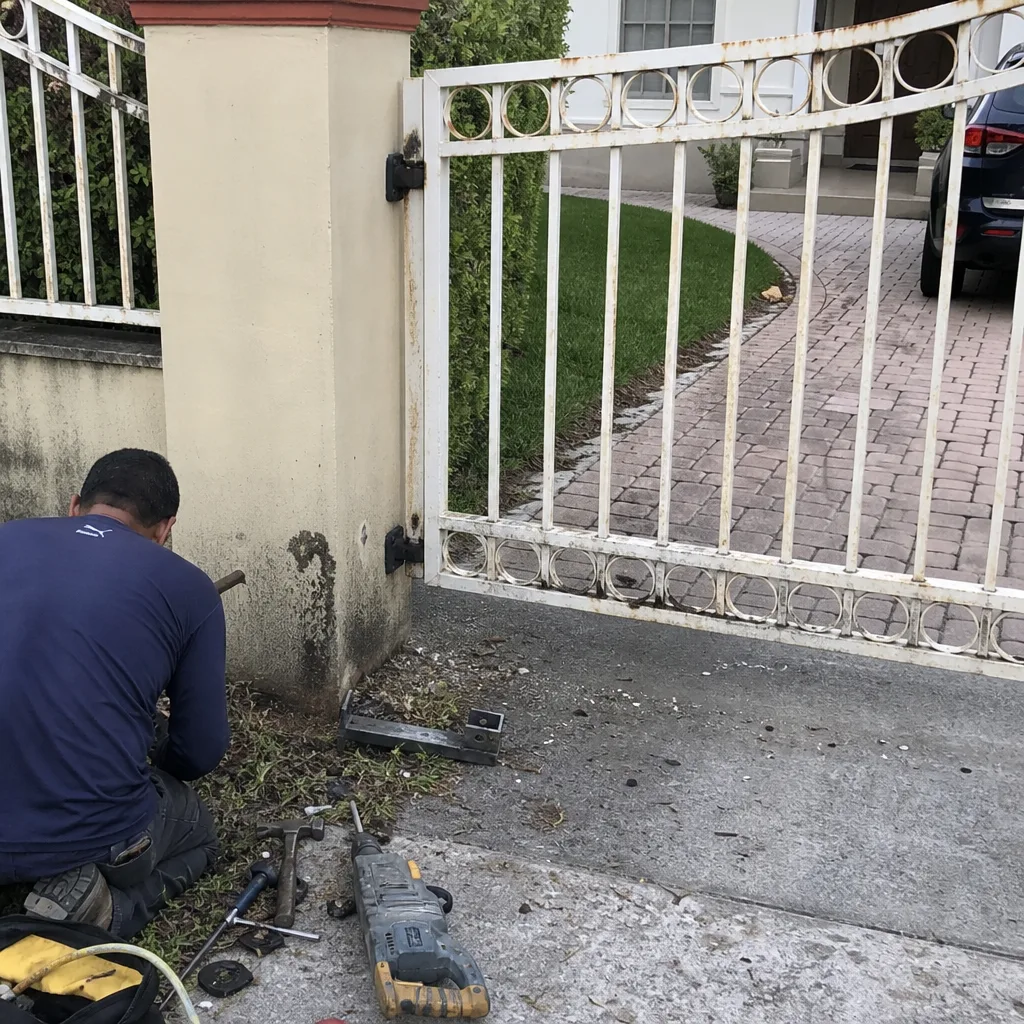 Before
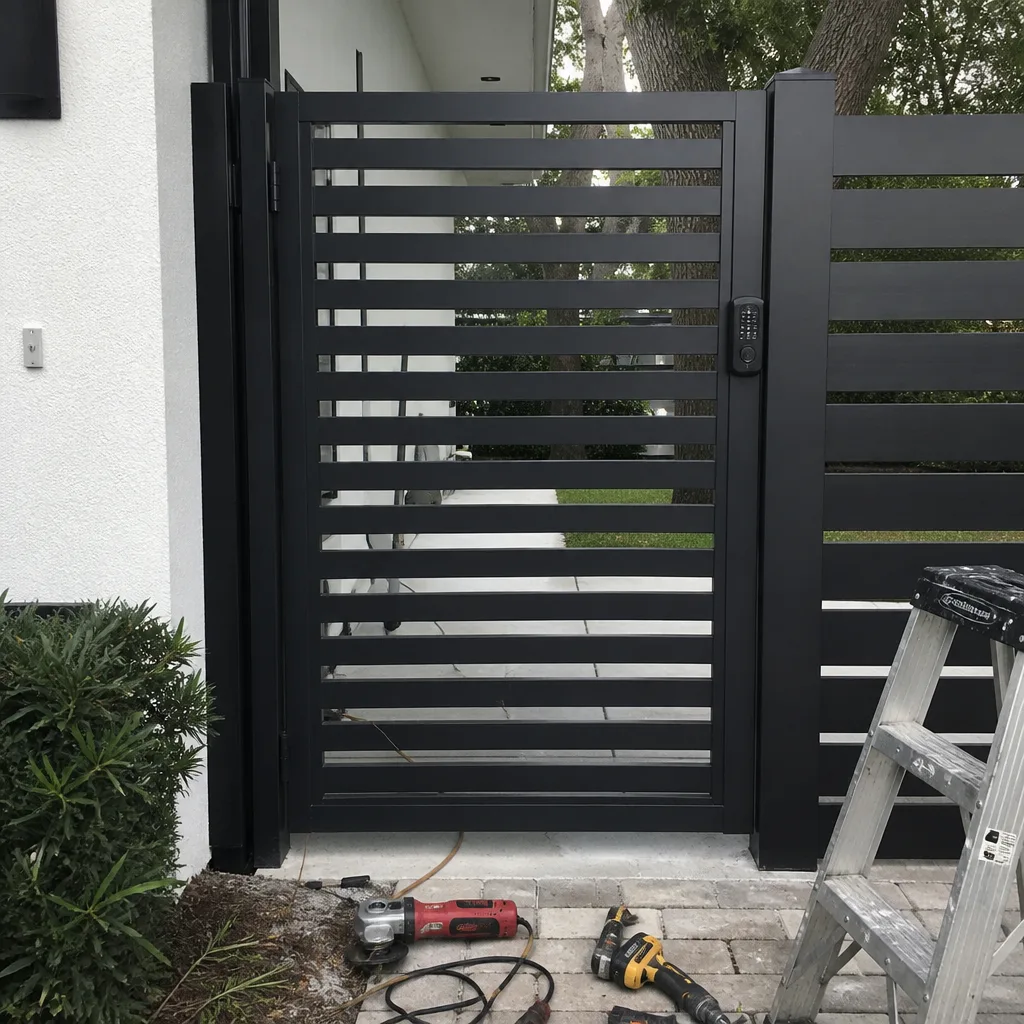 After
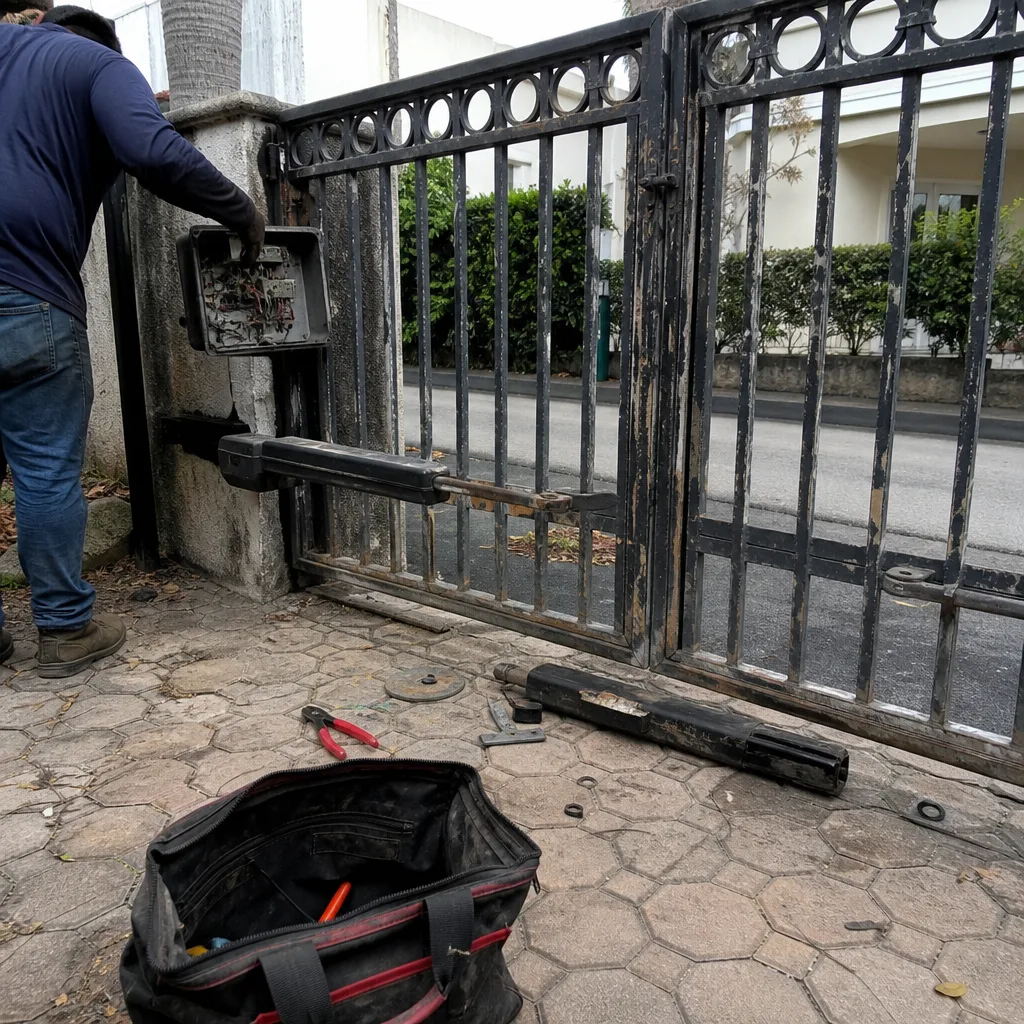 Before
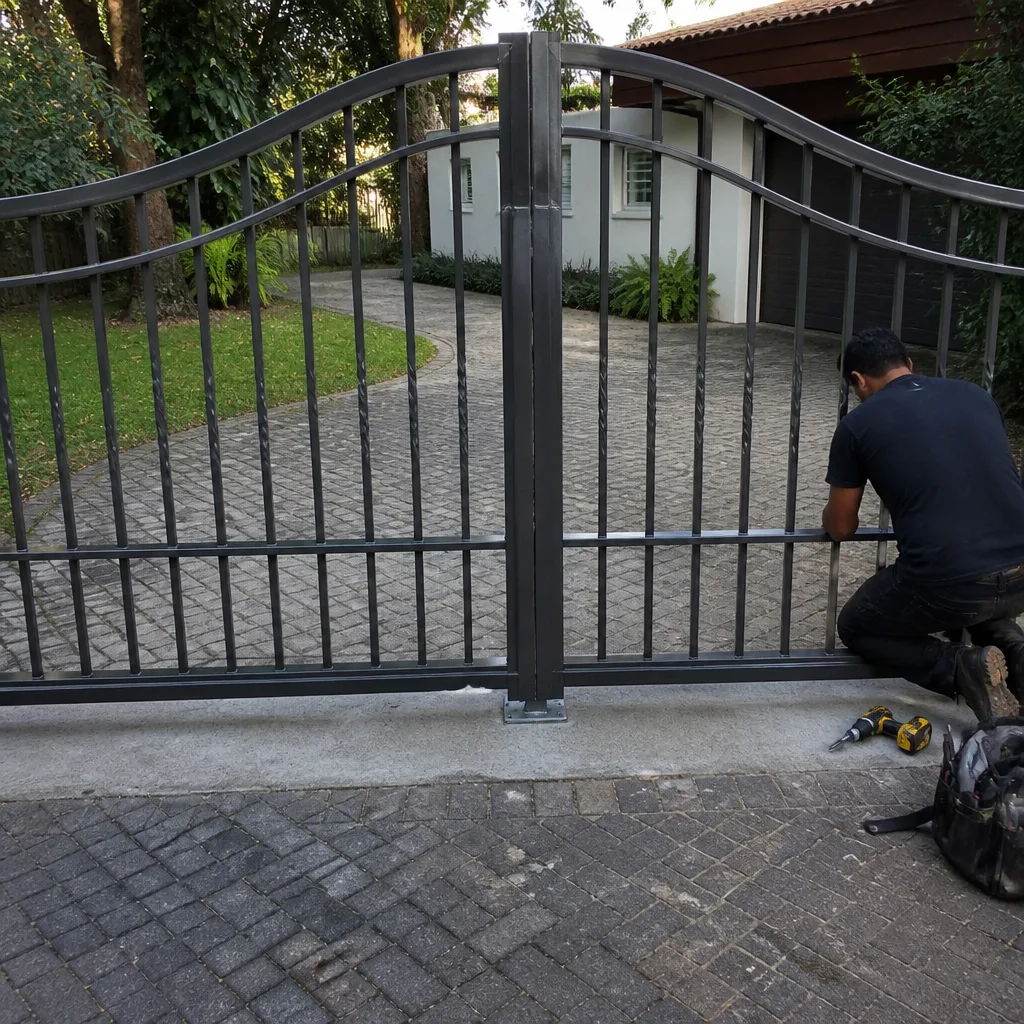 After
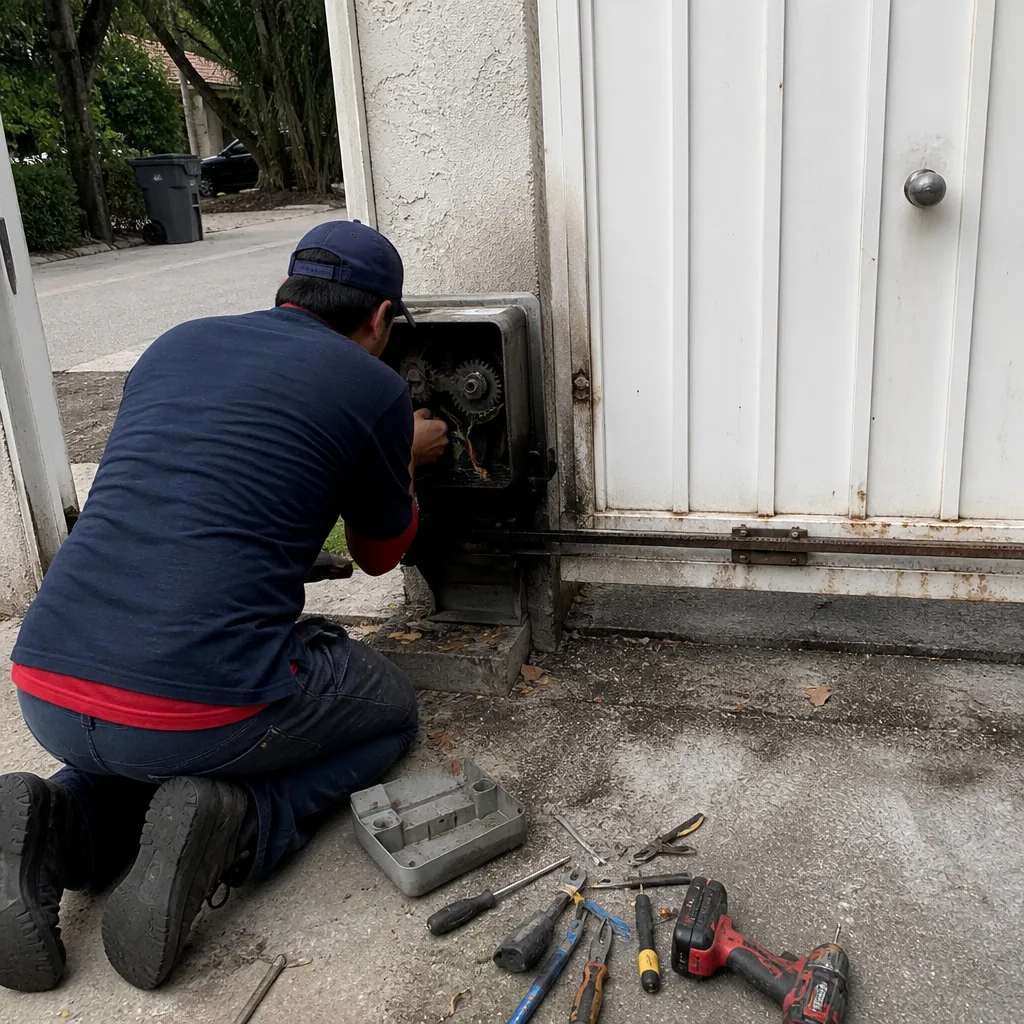 Before
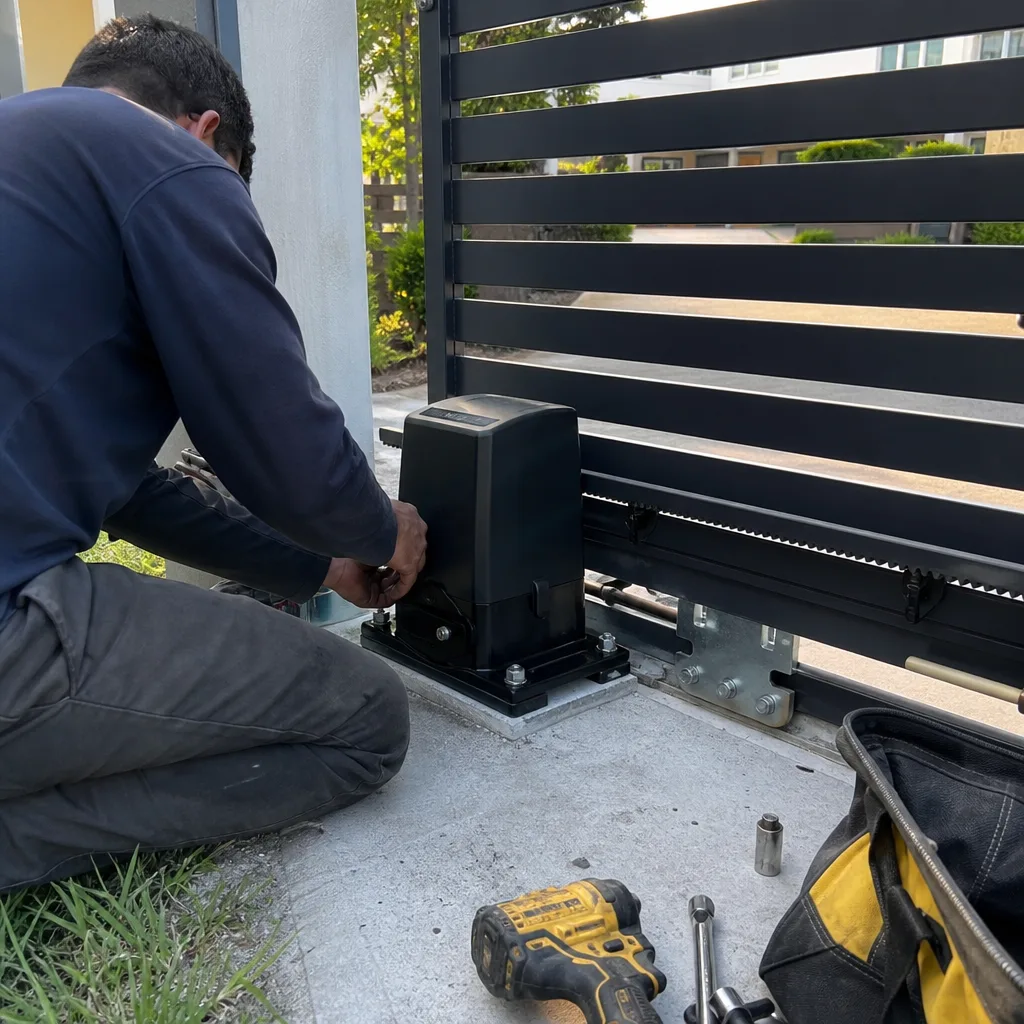 After